Start with a conversation
Clarify context, urgency, constraints and what the organisation already knows.
Service pathway
Glass Elephant helps construction organisations move from concern to practical action: scoping, discovery, route design, implementation, pressure controls and assurance.
The starting point depends on what the organisation already knows. Follow-on services are used where evidence shows a specific need.
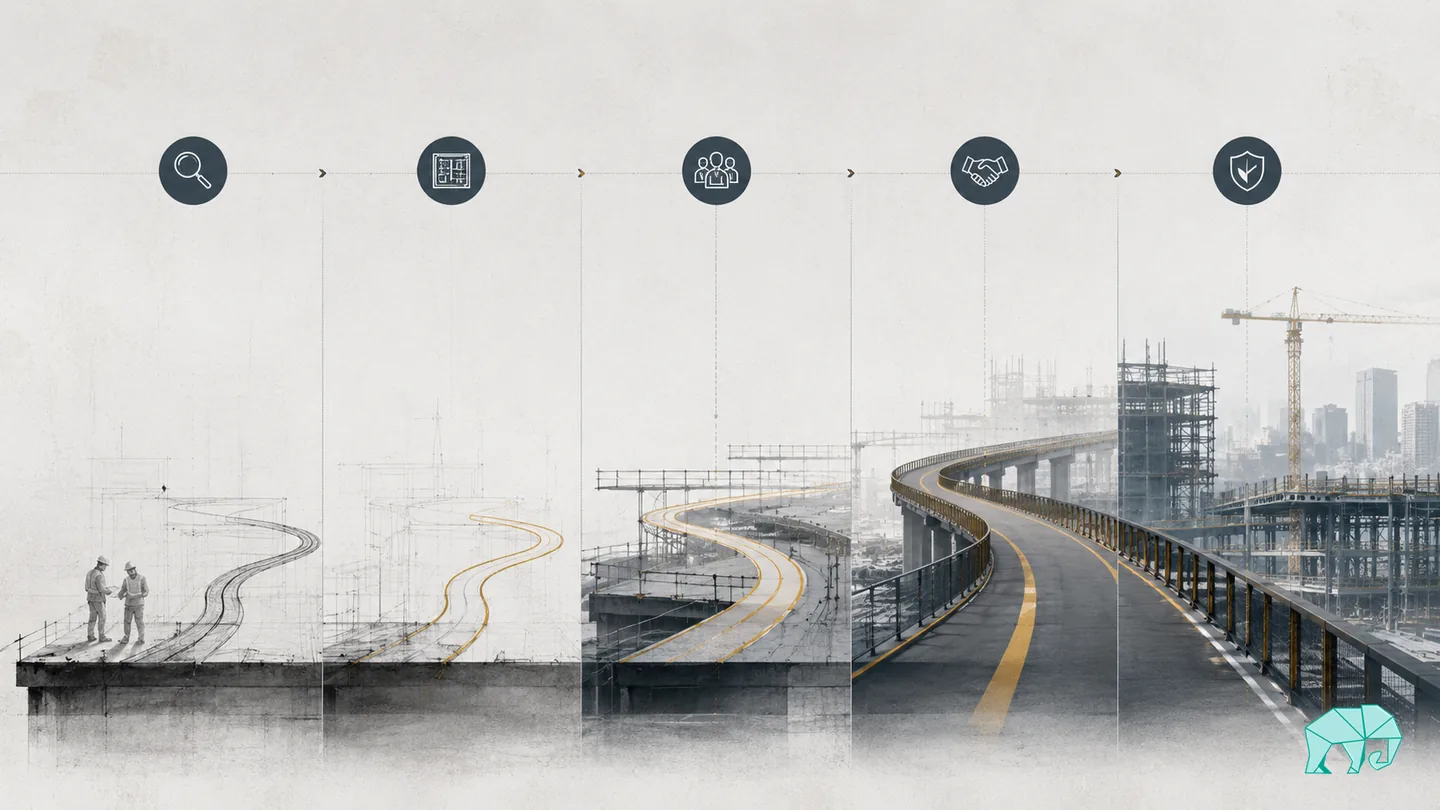
Simple buyer logic
You do not need to diagnose the right service before speaking to Glass Elephant. The first conversation clarifies what is showing up and whether the next step should be Discovery, a contained Pilot, implementation, assurance or a specialist follow-on service.
Clarify context, urgency, constraints and what the organisation already knows.
Discovery tests pressure sources, route clarity, role boundaries, support access, controls and assurance evidence.
The next step may be route design, role clarity, thresholds, handoff, pressure controls, implementation or assurance.
Use the one-page overview for internal referral conversations or a quick buyer scan.
Pathway
The service pathway is deliberately practical. Each step has a job to do, and each step should only be used where it helps the organisation move from concern to owned action.
Clarifies context, urgency, constraints, decision-makers, known concerns and the smallest useful starting point.
Looks for the route problem, not just the support list: pressure sources, route clarity, role boundaries, access, controls and evidence.
Turns Discovery findings into a proportionate next step so the organisation is not left with a report and no route forward.
Defines routes, role boundaries, decision thresholds, bounded response, handoff acceptance and follow-up ownership.
Supports adoption, sequencing, communication, leadership rhythm and early review so changes hold in practice.
Checks whether routes, controls, ownership, confidence and follow-up are working through proportionate evidence.
Reviews whether pressure routes and controls still fit the organisation, projects, supply-chain reality and emerging evidence.
What can be built
Who owns the next step, where concern goes, how handoff is accepted and what happens after signposting.
What managers, supervisors and colleagues can do, what they should not carry, and when formal routes are needed.
Controls for workload, planning, staffing, welfare, low control, role ambiguity, project pressure and supply-chain access.
Proportionate measures to test whether confidence, route use, handoff, follow-up and pressure controls are improving.
Glass Elephant is evidence-informed, practical and bounded. Read how evidence informs the approach.
Trust
Because this work can surface sensitive organisational information, Glass Elephant treats discovery findings, route gaps, pressure themes and client evidence as confidential client material. Outputs are shared through agreed routes and are not used publicly without explicit permission.
Next step
You do not need to choose the full service pathway before speaking to Glass Elephant. The first conversation is used to understand the right next step.
Discuss the Half-Day Pilot