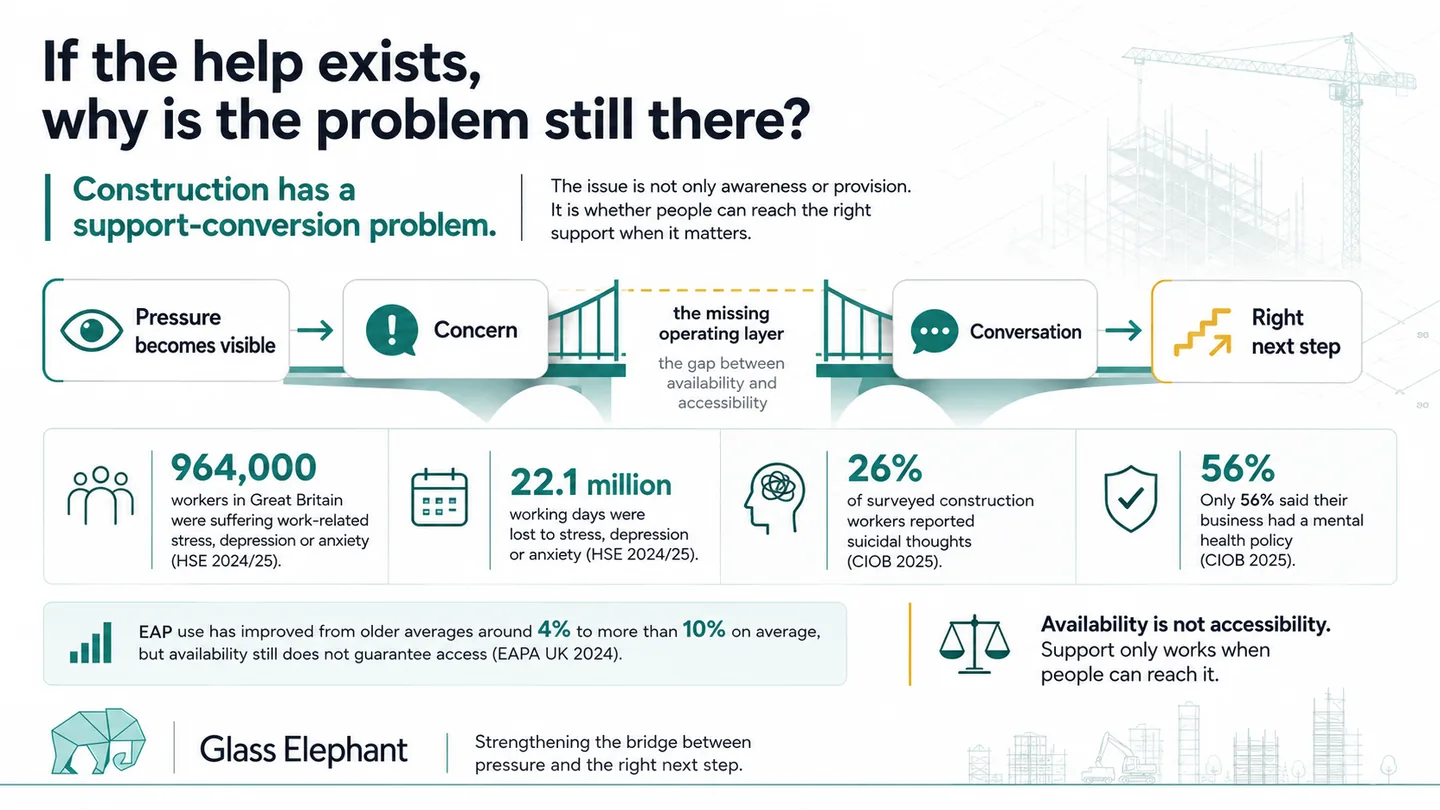
There is a conversation the construction industry has been circling for a long time.
It is not whether pressure exists. Everyone knows it does.
It is not whether support services exist. In many organisations, they do. There may be an Employee Assistance Programme, a mental health policy, a wellbeing page, a helpline number, a poster in the canteen, a toolbox talk, or a named person somewhere in the business.
The harder question is this:
What actually happens between someone starting to struggle and that person reaching the right support at the right time?
That is where the bridge often breaks.
The issue is not always the absence of help
Construction has become much better at talking about wellbeing, mental health, safety culture and support. That progress matters. It should not be dismissed.
But awareness does not automatically create access.
A poster does not guarantee a conversation. A helpline does not guarantee trust. A policy does not guarantee that a supervisor knows what to say when someone in the team is clearly not themselves. An Employee Assistance Programme does not guarantee that a worker, subcontractor, manager or site lead will actually use it when pressure is building.
This is the space Glass Elephant is designed to address.
We are interested in the practical middle ground between recognition and action.
The moment when someone notices a change but is not sure whether to say anything.
The moment when a manager knows something is wrong but worries about making it worse.
The moment when a colleague says, “I’m fine,” but everything about them suggests they are anything but fine.
The moment when someone finally discloses something difficult and the listener suddenly has to decide what is supportive, what is safe, what is confidential, and what needs escalating.
Those moments matter.
Construction is good at visible risk
Construction is highly skilled at managing visible risk.
Edges. Lifting. Access. Plant movement. PPE. Exclusion zones. Method statements. Permits. Toolbox talks. Emergency procedures.
The industry understands that risk cannot be left to good intentions. It has to be identified, communicated, controlled and reviewed.
But some risks are less visible.
Fatigue. Overload. Conflict. Shame. Isolation. Financial pressure. Constant change. Decision fatigue. The feeling that speaking up could make someone look weak, unreliable or difficult.
Those forms of pressure do not always arrive dramatically. They accumulate. They sit under the surface. They affect judgement, relationships, attention, communication and safety behaviour.
A person does not need to be in crisis for the pressure to matter.
“Speak up” is only part of the answer
Many organisations encourage people to speak up. That is useful, but incomplete.
People also need to know what speaking up leads to.
Who listens?
What happens next?
What stays private?
When does something need to be escalated?
Which route is appropriate?
What should a manager do if they are concerned but unsure?
What should a colleague do if they are trusted with something serious?
Without that clarity, “speak up” can feel like a risk rather than a route.
In real working environments, especially in construction, people may be managing pride, loyalty, fear, reputation, commercial pressure, job insecurity, subcontractor dynamics, or simply the belief that everyone else is coping better than they are.
That is why support has to be practical. It has to be visible enough, trusted enough and simple enough to use under pressure.
Managers do not need to become therapists
One of the most important boundaries in this work is that managers, supervisors and colleagues should not be expected to become therapists.
That would be unsafe, unrealistic and unfair.
What they do need is confidence in the workplace role they can properly hold.
They need to know how to notice early signs of pressure.
They need language that does not embarrass, interrogate or corner people.
They need to understand the difference between listening and taking responsibility for someone’s whole situation.
They need to know when to hold a boundary, when to signpost, when to escalate, and when to step back.
They need to know how to avoid the two common extremes: doing nothing because they feel unqualified, or doing too much because they feel personally responsible.
The useful position sits between those extremes.
Calm. Human. Bounded. Practical.
The missing middle
Most organisations have some form of policy at one end and crisis support at the other.
The missing middle is everyday capability.
What happens before crisis?
What happens when someone is not yet absent, but is clearly under strain?
What happens when a team is functioning, but the emotional temperature is rising?
What happens when a supervisor senses that pressure is affecting behaviour, but has no shared language for raising it?
What happens when people know support technically exists, but do not trust the route enough to use it?
This is where culture becomes practical.
Culture is not just values on a wall. It is what happens in small moments under pressure. The rushed handover. The sarcastic comment. The ignored warning sign. The quiet check-in. The manager who listens without overreacting. The person who knows what to do next.
Those moments either strengthen the bridge or weaken it.
Why Glass Elephant exists
Glass Elephant exists to name the things everyone sees but few people talk about clearly.
The pressure that is normalised.
The silence that is mistaken for resilience.
The colleague who has changed but has not yet asked for help.
The manager who wants to respond well but does not know where the boundary sits.
The support route that exists on paper but is not trusted in practice.
The gap between awareness and action.
Our focus is practical, workplace-applied and non-clinical. Glass Elephant is not designed to replace existing support services. It is designed to help organisations make better use of the support, routes and responsibilities they already have, while strengthening the everyday culture around pressure, conversation and appropriate action.
The aim is not to make every conversation heavy.
The aim is to make the right conversation easier when it matters.
A better bridge
A better bridge between pressure and support does not rely on one heroic person saying exactly the right thing at exactly the right time.
It is built through shared language, clear boundaries, trusted routes and repeated everyday behaviours.
It helps people notice earlier.
It helps managers respond without panic or overreach.
It helps colleagues understand what support looks like and what it does not.
It helps organisations move beyond awareness campaigns into practical capability.
Construction already understands the importance of routes, controls and visible systems.
The same thinking now needs to apply to pressure, stress and human strain.
Because when pressure is part of the work, recognising it and routing it safely should be part of the system.
That is the bridge Glass Elephant is here to strengthen. 🐘
Drag and Drop Website Builder